



A channel full of discoveries
At 08:41, Bea shared Lumen-3. At 10:17, Tom added SignalBrief. Maya returned after lunch with a LinkedIn thread about Orbit Agents. By 16:42, Leon had contributed the North Star prompt. Each message arrived with enough confidence to deserve attention and enough novelty to make the previous message feel slightly out of date.
FOMO is not only the fear of missing a feature. It is also the fear that someone else has already understood a new way of working while you are still deciding which link to open.The question starts innocently: what should I learn? Then every answer produces another answer. A new model, a workflow, an agent framework and a confident prompt arrive before the first experiment has finished. Sharing becomes a way to signal attention, even when nobody has had time to pay attention.
That is why AI FOMO can feel productive while producing very little judgment. The team was not resisting the technology. It was circling it, one plausible discovery at a time.
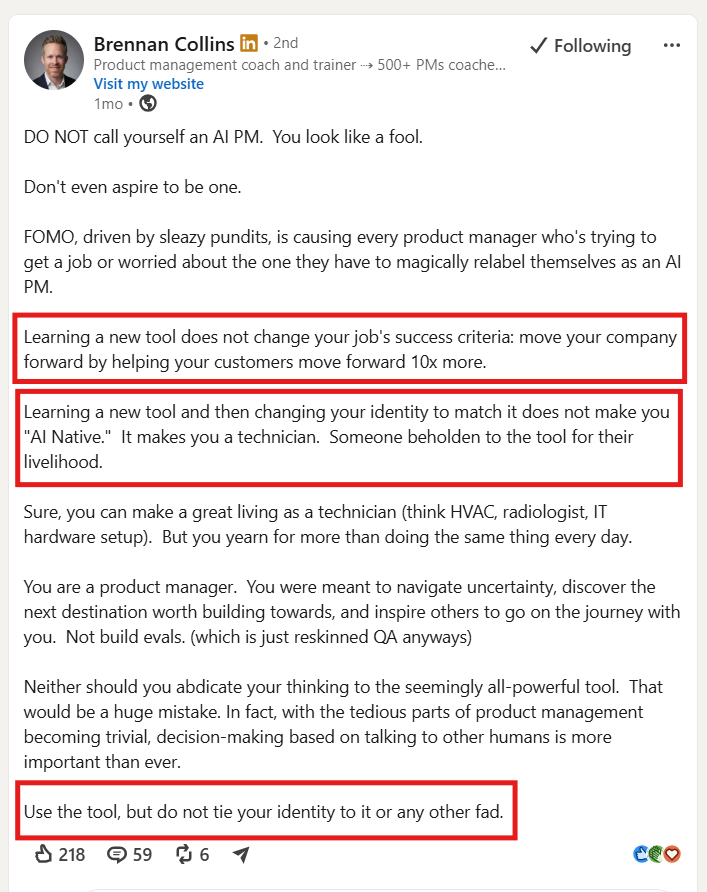
Brennan Collins captured the career-pressure version of this in a public post, warning people not to “call yourself an AI PM” simply because the market has made the label feel urgent. His sharper point is that learning a tool does not replace the success criteria of product management: helping a company and its customers move forward. (Brennan Collins)
The problem was not that the links were bad. The problem was that nobody had yet done the product work of asking what any of them was good for.
The first useful experiment
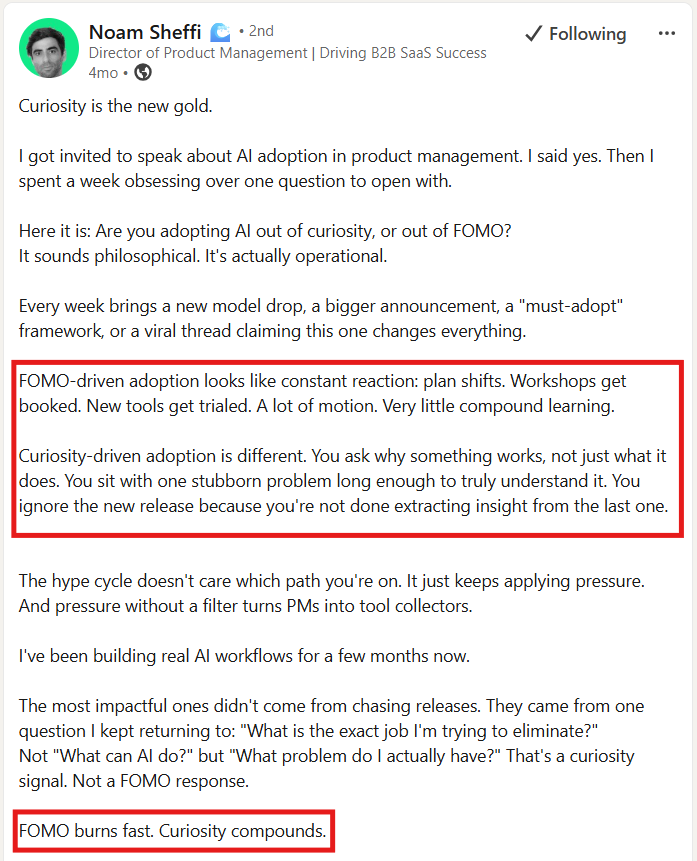
Noam Sheffi puts the distinction in a useful operational question: “Are you adopting AI out of curiosity, or out of FOMO?” (Noam Sheffi)
The question mattered because the two motives produced different behaviours.
FOMO creates reaction. The plan shifts because a new release appeared. A workshop gets booked before anyone knows which problem it is meant to illuminate. A team collects half-integrated tools and calls the collection an AI strategy. The work feels fast because the tabs keep multiplying.
Curiosity creates a smaller loop. You choose a question, test a capability, look closely at what happened and decide whether the result deserves another hour. You are allowed to discover that the tool is delightful, irrelevant, unreliable or useful only after a different prerequisite is fixed.The difference is not personality. It is the shape of the commitment.
The Productboard/UserEvidence survey of 379 product professionals describes widespread AI use alongside very uneven maturity. That sounded familiar. Adoption is not the same as understanding. (Productboard’s report)
The next morning, Nora proposed a small experiment with the customer-call workflow Tom had shared. Not a pilot. Not a roadmap item. Just enough time to see what it could do.
They chose three recent calls, gave the tool the same brief and read the output together. The first summary was generic. The second was useful. The third sounded impressively certain about a customer problem nobody had mentioned.
That was when the team began to have an opinion.
Playing together changes the question
There was something genuinely enjoyable about the experiment. Tom had brought the workflow, Maya challenged it, Elena knew which details mattered to Support and Leon kept asking whether the same idea could be made less awkward for the person using it.
The team was not watching a demo anymore. It was playing with a possibility together.
That pleasure was not frivolous. It was part of the product work. A PM could ask a better question because the idea was tangible. Design could react to something rough. Engineering could point out where the apparent shortcut hid a difficult system problem. The team could move from “could this exist?” to “what would make this worth using?” in an afternoon.
The danger came when the experiment was translated into “we should now deliver ten of these.” Exploration would become throughput. A useful shortcut would become a new baseline. The tool would not have become worse; the organisation would simply have stopped treating it as a way to learn.
My take
The healthiest response to AI FOMO is not abstinence. It is attention.Let the new thing be exciting. Open the tab. Make the silly prototype. Play with it alongside people who will ask different questions. Enjoy the moment when an idea becomes tangible before it has earned a roadmap slot. Then stop long enough to ask what you actually learned.
Product people do not need to adopt everything AI makes possible. They need enough contact with new capabilities to develop judgment about where those capabilities help, where they create risk and where they are simply delightful toys.
FOMO says the value is in being first. Curiosity says the value is in noticing.